Playing Chicken on South African Roads

“Yap youeeeeeeeeeeeeeeeeeeeeeeeeeeeeeee!” My husband yelled as we crested the top of the hill, perching over a steep decline. Down and down we drove, leveling only for a few seconds before climbing back up again. The roads were like roller coasters, rolling up and down, steep and narrow, with views far and near. We could see far and watch as impatient drivers moved into the oncoming lane, counting on speed and skill and luck to carry them beyond the slower car and safely back into the left lane only just in time.

We were driving in South Africa on the wrong side of the road (as far as we Americans were concerned) from the Wild Coast to Lesotho.

“Yap youeeeeeeee,” he yelled, as our speed increased to pass the slow moving truck, passing to the right, moving into the opposite lane, moving fast and faster, our speed well exceeding the speed limit until we slid in front of the truck just as that car coming toward us was getting near.
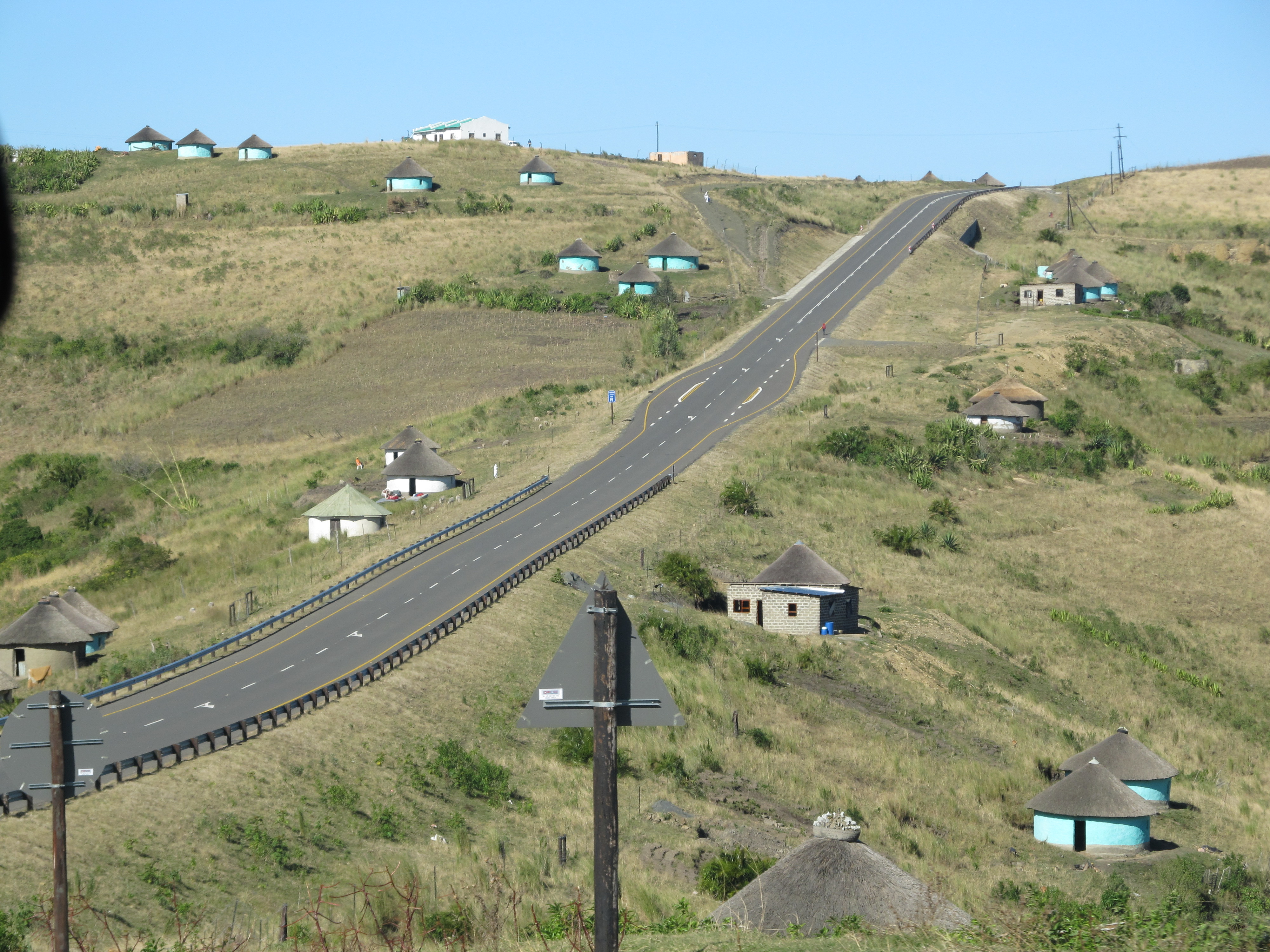
We played chicken more than once, so many times that it became blasé to the driver, my husband. Sometimes I shut my eyes, intimidated by the signs, “High Accident Zone,” intimidated by the website I’d stumbled across which detailed the roads with the highest fatalities (this was one of them). Or I’d look beyond the pavement, at the termite mounds, the grasses, the clothes lines adding color to the earthen shacks and huts around them, and hope for the best.

For road safety advice for foreigners driving in South Africa, check out the website: www.arrivealive.co.za.
The South African Balancing Act

Have you ever tried to carry anything on your head? Maybe a book to practice your good posture? What about a bunch of sticks or a 10-liter bucket of water? How about a large bag of maize?

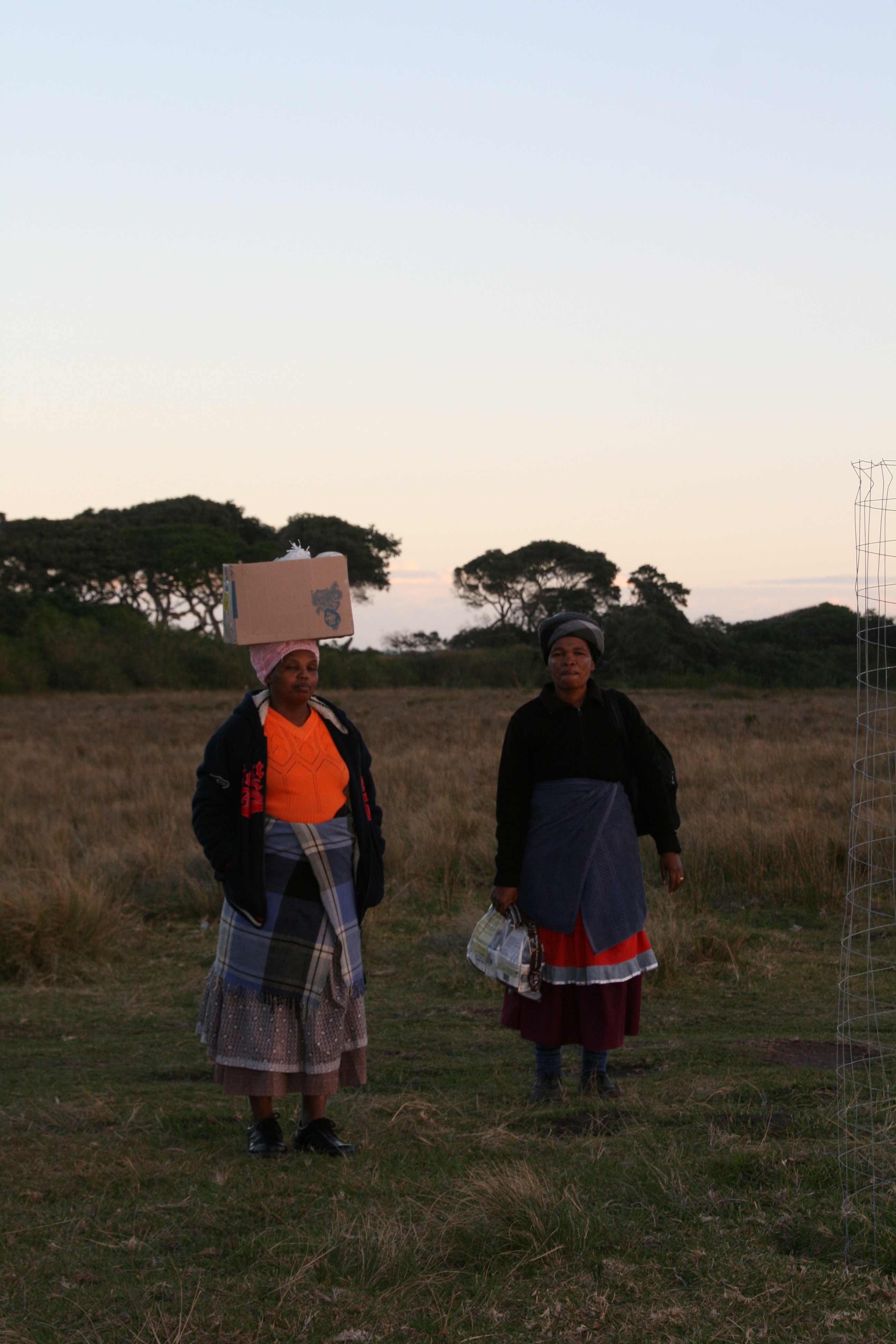
In South Africa we saw women everywhere carrying everything and anything on their heads. Most of the time their hands were free and often babies were on their backs. According to one young woman, the girls begin learning the technique when they are 8-years old. My daughter was 13, and I was a few years older when we tried.

On the “Women’s Power Tour” in Bulungula on the Wild Coast of South Africa, our guide, Mtomboxolo, took us to the village spring. She gave us each a small container (margarine size) and told us to fill it up with water, cover it with a lid, then put it on our heads before carrying it up the hill on a rooted dirt path. Tentatively, I put the tub on my head and walked up the hill, both hands by my sides. A few minutes later we arrived at the hut, our water intact. Proud of myself, I turned to see Mtomboxolo carrying a much larger container on her head.

Now it was time to gather wood. We walked to a wooded area with small trees and shrubs and gathered dead branches. Mtomboxolo gave us fabric to tie up our bundle, then, to my surprise, told us to carry the bundles on our heads as well. I retied mine, placed it on my head and balanced the lopsided bundle back up the hill.

Around a fire that night, we spoke to an orthopedist who volunteers in the village. She told us that many women come to her with back pain yet even after telling them to stop using only their heads, she will see them later that day, balancing heavy loads, their arms and hands empty and free.

Playing Marbles on the Wild Coast

We played marbles, my daughter, a young African boy, and I, one sunny morning on the Wild Coast of South Africa.

I meandered along the fine sandy beach, the morning sun’s warmth increasing, the wind less than the day before. My daughter walked near me, searching for shells or some creatures of the sea.

Around the curve of the coast, a little boy appeared near us, his black eyes big and friendly. Picking up a round seed, the size of a marble, he flicked the seed with his thumb, shooting it far along the wet sand. My daughter followed, taking her turn and learning quickly. He saw me watching and gave me a seed and motioned for me to play, too. Using a stick to create a line in the sand or his hands to dig a shallow hole, he showed us what to do, flicking the seed as if it were a marble. Shooting and flicking and sometimes tossing the marble, we followed his lead, doing what he showed us with no words.

He told us his name was Paul and that he was 6 years old. He counted to 100 in English and drew the alphabet in the sand, reciting each letter as he wrote with a stick for a pencil. He wore a torn Michigan sweatshirt and sweatpants and bare feet and when he tried on my daughter’s sunglasses, he posed in a typical “cool” manner, leaning back, his arms crossed until we laughed.

Around the corner from where we played, several women appeared, with tall buckets on their heads. Wearing long skirts and shirts, their heads covered in fabric, they walked with their hands free, nodding as they passed, continuing on beyond the river mouth to the colorful thatched roof huts on the hills.

When it was time for us to go, we said good bye to Paul and left him playing on the beach, marble in hand.

Bulungula

From the fenced dirt parking lot, we followed the hand painted signs pointing the way to Bulungula. Lugging our daypacks and rolling our small suitcases behind us, we walked the 500 meters to the lodge along a narrow dirt path, bordered by green colored huts to our left and the steep rise of a hill to our right.

We found the lodge at the end of the path: a rectangular building painted turquoise on the outside, brightly painted on the inside. Futon couches surrounded low tables, pillows littered the floor near a book case, large picture windows brought the ocean and the river inside. In the main lodge we found the kitchen, complete with communal refrigerator, a cooking area for guests and a separate kitchen for the village chefs.

A young woman of the village, Andiswa, showed us our room, a peach colored rondavel where the four of us slept on futons. Down the path, between the main lodge and our hut, were the bathrooms, one hut for the composted toilets and another for the rocket showers.

During our 3 days, the boys in our family chose to fish in the surf while the girls learned to grind maize; the four of us paddled the Xhora River, sighting kingfishers and mangroves. We ate curried butternut squash and chicken crepes for lunch, the only diners in the local restaurant’s rondavel. We sat around the fire in the evening, walked along the beach at sunrise and took a village tour. Andiswa introduced us to the healer of the village. We watched village children dance and sing. We learned about the local customs, watched children playing soccer, tasted sorghum beer and walked back to the lodge in the moonlight.

Over dinner, we joined other guests and the owners. We met backpackers, families from Colorado and France, and doctors from South Africa who were volunteering their talents and efforts to help the people of the local villages. We learned about the new preschool and the Bulungula Incubator, a non government organization (NGO), and its efforts to improve village life in the areas of education, health and nutrition, sustainable livelihoods, and basic services (including water quality and access to electricity).

There are things we didn’t do, like horseback riding on the beach, hiking, gathering herbs with a local healer, swimming in the ocean or trying out the solar shower. Next trip we’ll spend a week at Bulungula.

On the Way to the Wild Coast

Bumping and tilting, lurching and laughing, we eased over and through the rutted and pot hole filled dirt road on our way to Bulungula. Thankful for the clearance of our Renault Koleos, a small SUV sold in South Africa, we edged onward as the road dipped down and curved along the hill, taking us ever so slowly to our destination on the coast.

When our South African friends told us about Bulungula Lodge, they described it as a paradise, a beautiful, relaxing place where we could learn about the local people; after checking out the website, www.bulungula.com, I knew I had to go there. I wanted to experience this place that is solar powered and 40% owned by the village. I wanted to go to this place where I could learn to carry water on my head, eat South African food, walk on the beach and kayak on the river. We changed our itinerary, adapted our route and added an extra week to squeeze in a 3-night stay.

Before we left the U.S., we called David, the lodge’s owner, not once but twice, asking questions about the roads. We scrutinized websites and blogs which described the route and debated renting a 4 x 4. We considered leaving our car in Mthatha and taking the shuttle to the lodge. But David patiently reassured us. He told us that 60% of the people who stay at Bulungula use 2 x 4 cars to get there. We printed out the driving map and instructions from the website, left ourselves plenty of daylight hours, and hoped for the best.

After filling up on petrol, we took a left off the N2 and followed cars and open trucks crammed with people and women singing, passing small buildings and a telephone box before we turned off the tar road onto dirt. Colorful round huts and square buildings accented the rolling hills; a store, a school, cattle crossing, a dog, children yelling, “Sweets!” People walked only a little slower than we drove, and they smiled and waved as we passed by. The sky was blue and clear, the green hills rolling to the sea. A man in a suit walking by told us we were going the right way, and we continued, eventually seeing the peach and turquoise colored huts at the river mouth, our destination.

Getting to Bulungula Lodge isn’t easy, and that’s a good thing. It took us 3 hours to drive 79 kilometers (that’s only 49 miles) to reach Number 11 on the Rough Guide’s list of “Things Not to Miss in South Africa.”

Connecting

Blank faces met ours as we drove into the petrol station. Expressionless, the men pumped our cars. Until we tried to speak their language. “Molo,” we said in greeting. “Molweni,” he replied. We were practicing the few words we knew in Xhosa, the language of the Western Cape and Eastern Cape provinces of South Africa.

Communicating in South Africa is easy for those of us who speak English. Most South Africans speak at least some English, one of the 11 official languages of the country. But according to the 2001 Census, English is the fifth most common language spoken, outspoken by Zulu, Xhosa, Afrikaans, and Sethoto sa Leboa.

During our walking tour of Langa Township, Siviwe, our tour guide taught us a few words and even taught us how to click. Though the rest of us tried, only my daughter is able to click correctly, making the sound with her tongue as she pronounces the hard c sound in the word Xhosa. We learned the simple greeting, “molo,” when meeting one person, or “molweni,” when meeting more than one. And we learned how to say thank you, “enkosi.” As Siviwe brought us into the shantytown homes, we were able to greet those who lived there in their own language and to say thank you for allowing us to see their homes.

“Enkosi,” we said as we gave the man a tip for pumping the gas and cleaning our car windows. He smiled then grinned when my husband asked him if he was a Chiefs fan.

“Go Chiefs!” we all called out from the car, holding up our fingers in the American peace sign, also the sign for one of the biggest soccer teams in South Africa. He laughed and poked his friend who was a fan of the Chiefs biggest rival, the Pirates, and they cheered as we drove away.

We drove toward the coast, passing children walking down the dirt road. As we held our fingers up high with the sign for the Chiefs, they jumped up and down and ran after us yelling, “Chiefs! Chiefs!”

The people at Bulungula Lodge encouraged us to learn a few more words of Xhosa and to communicate with the people we encountered in the village. We learned to respond when someone asked how we were and to ask about their health as well.

I learned to say thank you in Sethotho (“galiboha”), and although my pronunciation was corrected by the women of the village, we all laughed together.

As we moved away from the coast, traveling to other provinces where Xhosa is not spoken and other languages are dominant, our lack of words separated us from the people. We never learned any Afrikaans or any Zulu, relying only on English to get us by. And although we attempted to smile and to talk to those we met, our response was most often a blank stare. Without knowing a few words, we had lost our connection and our individuality, becoming just another tourist in a sea of faces going by.

South Africa in the Winter

I watched the news one morning in our apartment in Cape Town, surprised to see snow in Johannesburg. Even though I knew it was winter in South Africa, it was July and we’d only just left summer in the U.S. A day, a plane ride, and a 3-hour car ride later, we arrived in Kokstad, South Africa, southwest of Durban and 1302 meters above sea level (or 4272 feet).
The owner of our B&B warned me before we left the U.S. “It’s cold,” she said. “Bring a scarf.” And I did. What she didn’t tell me was that her lodging had no heat. And no insulation. It was 3 degrees Celsius (that’s 37 degrees Fahrenheit) when we arrived at her place about 5 p.m. She had our little country cottage ready for us with two portable electric heaters working over time. Pointing out the fireplace, the owner told us she had closed it since some prior renters had burned the mantle. So we had no choice but to freeze.

Wearing long underwear, wool socks, fleece jackets, hats, scarves and mittens, we cooked a pasta meal and drank hot tea and hot chocolate to warm up. After dinner we huddled around the insufficient heat of the heaters, laughing at the absurdity of the place and the expense. We were paying almost $200 to stay there!

We headed to bed early. The kids wore wool hats; their sheets warmed by electric blankets. My husband added a throw rug on top of our bed which lacked its own electric blanket. Somehow we slept and survived the inevitable cold midnight trip to the bathroom waking at 7 a.m. to the sound of the maid setting the dining room table for breakfast. In spite of the zero degree temperature (Celsius), I found the kitchen door wide open as she brought food and dishes back and forth from the main house. The sun was up casting its warmth against the icy car windshield, the patches of snow behind the cottage, and the freezing ambient air.

We ate our hot breakfast quickly before it cooled, packed up the car and left the peaceful and charming, but cold, dairy farm for the warmth of our SUV, heading west and south toward the coast and warmer weather.

Cape Town Dance Troupe

Happy feet stomped and danced across the small open garage to the beat of a drum. Swirling and sashaying, children of the Langa Township, from 3 to 18 years, stomped and chanted and shouted and sang song after song. First the youngest, then the oldest, then all together as they sang the South African National Anthem, loud and clear. We stood just outside the garage watching the children perform, enraptured with their energy, enthusiasm and excitement. Their smiles infectious, we never stopped smiling ourselves.

Turning our hands over and over, little girls touched and stroked our palms, shyly at first. They held our hands and touched our straw colored long hair, so different from their own black hair, kinky and cut short, so short that sometimes it was difficult to tell the boys from the girls. Together we watched the others singing and dancing, the girls, in a circle and in a line, using their hands and knees and feet to dance to the beat of the drum. The boys wore rubber miner boots, stomping and clapping against the boots with their hands in rhythm and in sync.

Siviwe, our township tour guide, directs the Happy Feet Youth Project from the Langa Township in Cape Town, South Africa. While instilling in the children a purpose and hope, he provides the kids with something to do after school. He feeds the children snacks, teaches dance and song routines, provides instruments and props, gives the children uniforms, and brings them to competitions around the country.

We clapped and clapped to the beaming, smiling faces, so proud and so happy. We waved and left the township, smiling ourselves, infected by the joy and hope of these children.

Photo on this post by Tommy Taft.

Tour of a Cape Town Township

Broken glass lined the wall’s edge only steps away from the V&A Waterfront in Cape Town. Like barbed wire but prettier, the jagged glass edges sparkled and reflected the morning sun, its sharpness a deterrent to thieves, intruders. Gates and high walls and barbed wire surrounding and shielding wealth and money.

From the highway you can see the shanty towns, metal and cardboard sheeted houses just big enough for a bed or two and a small kitchen. Bathroom down the dirt road in an outhouse by the river. Litter strewn and blown around. Children running and playing. Women washing clothes by hand.

Others live in dormitories. Three families to a room with only three beds and a TV. Children under 5 sharing the family twin bed with their parents, older children in the hall, sleeping mattress to mattress.

We walked through Langa Township, its resident, Siviwe of Cape Town Township Tours, our guide. We learned how to say a few words in Xhosa trying our best to click. We learned to greet people in their language as we entered their homes and learned to say thank you as we left. We watched women searing sheeps’ heads, making “smilies” a local delicacy. We passed small stores with hand painted signs. We saw a bed and breakfast and even a BMW. We learned that the community feeling is so strong that even those who make it big, the soccer stars for example, don’t want to move out. Instead they build a brick house in the “wealthier” area of the township.

Our tour ended with the children, dancing and singing, their smiles and talent giving us all hope for their future.

Photos on this post by Tommy Taft.

Highway Driving in South Africa

Imagine driving down a four lane highway. In Boston, you’re on Route 495, in San Francisco, you’re on Highway 101. Now imagine you’re driving on the left. As the driver, you’re sitting on the right side of the car, the stick shift is on the left (automatic isn’t an option), and the fast lane is on the right. Now imagine pedestrians walking down the road. That’s right. There is no side walk, no place for walkers, but they are there. Walking. As cars whiz by. Oblivious. The women balance jugs on their heads. The men and boys carry sticks to herd along the cows, goats or sheep.

That’s what we experienced as we drove over 2000 miles in South Africa.

As we drove along the edge of a hill, we often saw people walking only a few feet from the road and from cars driving 120 kilometers an hour or more (that’s about 75 miles per hour). As we encountered “High Accident Zone” signs, cars and trucks appeared around curves, driving fast and inconsistently, swerving and passing when the road narrowed to one lane but the speed didn’t slow.

When road signs warned of unfenced areas, we knew anything, people or animals, could meander into the road and cross our path without warning. But nothing slowed the traffic more than a heavy loaded truck, barely plugging along on the ungraded highway.